

causality
AI-Decisioning


The AI market is a bit like the Wild West. "AI Washing" - slapping an AI sticker on a standard rules-engine - is rampant. If you are a CFO or executive approving a purchase for "Marketing Optimization" or "Revenue Uplift" software, you need to look past the sales deck.
Here are four "Silent Killers" of ROI in AI Decisioning, and how to spot them.
Many AI vendors will show you a stunning case study. Two months after you sign the contract, performance drops off a cliff. Why?
It’s often due to Model Decay. Most legacy systems (e.g. Contextual Bandits) poison their own well. As they learn from their own past decisions, they create a feedback loop that reinforces their own biases, eventually confusing the algorithm.
Revenue Uplift over time
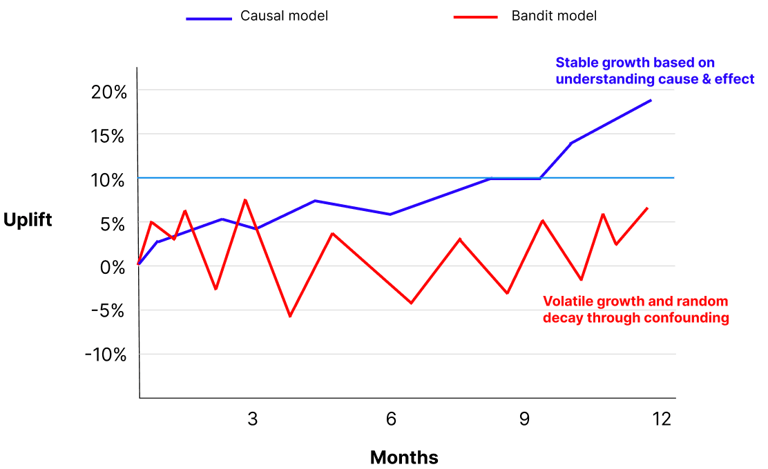
The Ask: Ask the vendor if they can share comprehensive (anonymized) data demonstrating the uplift they have generated for their customers over all deployments and all time.
Vendors love to promise they can optimize everything simultaneously: The Channel, The Subject Line, The Image, The Time of Day, The Offer, and The Font Size.
Mathematically, this is a trap. The more variables you add, the more data you need. The difference is exponential. If you try to optimize 10 variables with an audience of 50,000, the AI will never reach statistical significance on any of them. This is called the Curse of Dimensionality.
The Ask: Be wary of vendors promising to optimize every pixel using every data point. Look for a partner who focuses on determining and changing the high-impact levers first.
Some vendors "manufacture" uplift by simply turning up the volume. If you send four emails a week instead of one, your total revenue will likely go up in the first 30 days. The vendor then claims this spike as proof of their AI’s "intelligence."
In reality, this is a false positive. Over-communication creates a "burn rate" on your audience. While short-term engagement looks good, the long-term data usually reveals a "frequency tax": increased unsubscribes, "inbox fatigue," and customers who actively disengage from your brand. You aren’t optimizing; you’re just shouting louder until people quietly leave the room.
The Ask: Ask the vendor how their model determines the optimal frequency for each individual. A true AI solution shouldn't just decide what to send, but if it should send anything at all. Demand to see the impact of their tool on long-term retention and unsubscribe rates, not just immediate click-through uplift.
This may sound ridiculous, but it is the ultimate stress test. Sometimes, an AI engine outperforms your legacy manual campaigns simply because your manual campaigns were bad - not because the AI is good. A random coin toss might have beaten your legacy campaign too.
The Ask: Demand a rigorous control group.
If the AI can’t beat the Random group by a significant margin, you are paying for snake oil.
True Causal AI Decisioning is a revenue engine, not a cost center. It doesn't just "shout louder" or "guess better" - it understands the underlying cause of customer behavior to drive sustainable, long-term growth without hitting a performance cliff.
But navigating this market requires a buyer who asks the tough questions. We invite you to ask us those questions because we built our technology to answer them.